Black Marlin Defense Bi-Weekly: September 19th, 2025
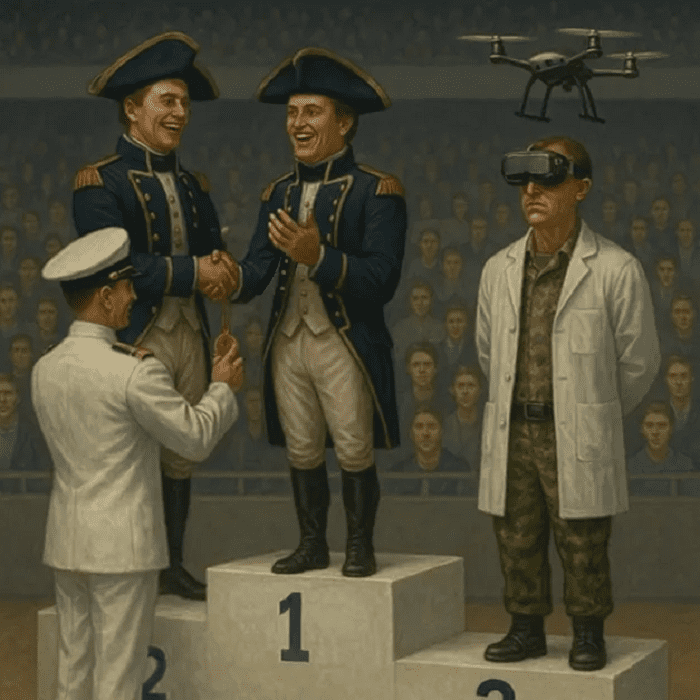
The United States Navy currently stands at an inflection point. One path leads deeper into traditional hierarchies, long procurement cycles, rigid promotion systems, and valorization of preserving legacy platforms. The other path leads toward a more flexible, entrepreneurial culture, one that rewards innovation, fast feedback, disruptive thinking, and adaptive leadership.
We see in Ukraine what happens when militaries cling to yesterday’s logic. Drones, digital fire control, distributed operations, and asymmetric tactics are not fringe. They are central. Reluctance to adapt now could cost us defeat at sea.
The Innovator’s Dilemma Afloat
Clayton Christensen’s The Innovator’s Dilemma warns incumbents that the very systems of processes, values, and metrics that bring past success become barriers to future relevance. In the Navy, the “golden path” of traditional tours, commands, warfare specialty milestones, and ship command is still the core of how success is measured. Officers who step outside that line, who join organizations like DIU, NavalX, SCO, or the Naval Rapid Capabilities Office, who experiment or pivot, often find that following innovation results in career risk: sidelining, invisible labor, and minimal reward in the system’s metrics even when they generate real value.
Corporate entrepreneurship research shows that most internal ventures fail not from lack of creativity but from structural resistance: budget rules, HR practices, and promotion boards, what Christensen would call “antibodies.” The rice bowl fights, where existing domains feel threatened, are lethal. If the Navy does not restructure what it rewards, then innovation cells, over the long term, will be starved, purged, or ignored.
Learning from History: Kenneth Whiting and the Prediction
One of the best historical analogs is Captain Kenneth Whiting. Interwar, he pushed for aircraft carriers long before they were widely accepted. He is sometimes called the U.S. Navy’s “father of the aircraft carrier.”
In 1922 Whiting said:
“That carriers will be successful, and an absolute necessity to any well-equipped navy in the future, there is not the slightest doubt in my mind.”
What happened to him? Whiting continued to advocate actively. He helped design or oversee construction of five of the first six U.S. carriers. He served as executive officer of the first two carriers, and acting commanding officer of the first U.S. carrier to enter service. His experiments and risk-taking tours ultimately made carriers central to U.S. naval power during WWII.
Whiting’s career shows that forward-leaning, experimental leadership paid off, but only because he had enough institutional backing that his advocacy was taken seriously, enough space to experiment, and enough protection from career destruction for being early.
Where Innovation Must Be Protected and Rewarded
To avoid defeat at sea, the Navy must explicitly protect and empower its officers and their time at innovation cells, which include:
- DIU (Defense Innovation Unit)
- NavalX
- SCO (Strategic Capabilities Office)
- Naval Rapid Capabilities Office
These organizations are doing the hard work of innovation: experimenting, prototyping, integrating emerging technology, and showing what is possible.
We must make participation in them count toward career advancement as if they were on the golden path. That means:
- Recognizing tours in these organizations as equivalent in value to traditional command tours, ship commands, warfare specialties, and similar benchmarks.
- Rewarding officers who generate measurable results: fielding drones, improving fleet resilience, and enabling autonomy or AI-assisted decision cycles. Not just those who talk loud or make noise, but those who act, produce, and deliver.
- Creating “intrapreneurial tours” that are explicitly designed to test new operational concepts, with promotion boards, mentorship, and recognition aligned to their risks and outcomes.
The Road Ahead: Culture Must Shift, And Fast
If the Navy does not adjust, we are very likely going to sail into tomorrow’s war with yesterday’s capital assets. The cost is not merely bureaucratic inconvenience or institutional discomfort. It is the risk of real loss: ships, lives, and strategic advantage.
The Navy must reward, promote, and elevate a culture of intrapreneurial tours. Identify mavericks, not just those who yell from the rooftops, but those who quietly deliver value. Build systems where experimentation is not punished but rewarded. Restructure promotion boards, command pipelines, and resource allocations to incorporate innovation metrics.
We are at the Whiting moment again. History does not wait for the slow or the cautious. Ukraine is our proof. We need bold acts now.
We are here again. The lesson of The Kill Chain is clear: the future of naval warfare is in our face. We must act. Time is running out.
References
Brose, C. (2020). The Kill Chain: Defending America in the Future of High-Tech Warfare. Hachette Books.
Christensen, C. M. (1997). The Innovator’s Dilemma: When New Technologies Cause Great Firms to Fail. Harvard Business School Press.
Garvin, D. A., & Levesque, L. C. (2008). Meeting the Challenge of Corporate Entrepreneurship. Harvard Business Review, 86(10), 102–112.
Whiting, K. (1922, February 18). Aircraft Carriers: Floating Homes for Naval Planes. Literary Digest. (As cited in sources discussing Whiting’s interwar advocacy).