A fair question has emerged with the decommissioning of the Avenger-class minesweepers: was there not a replacement plan?
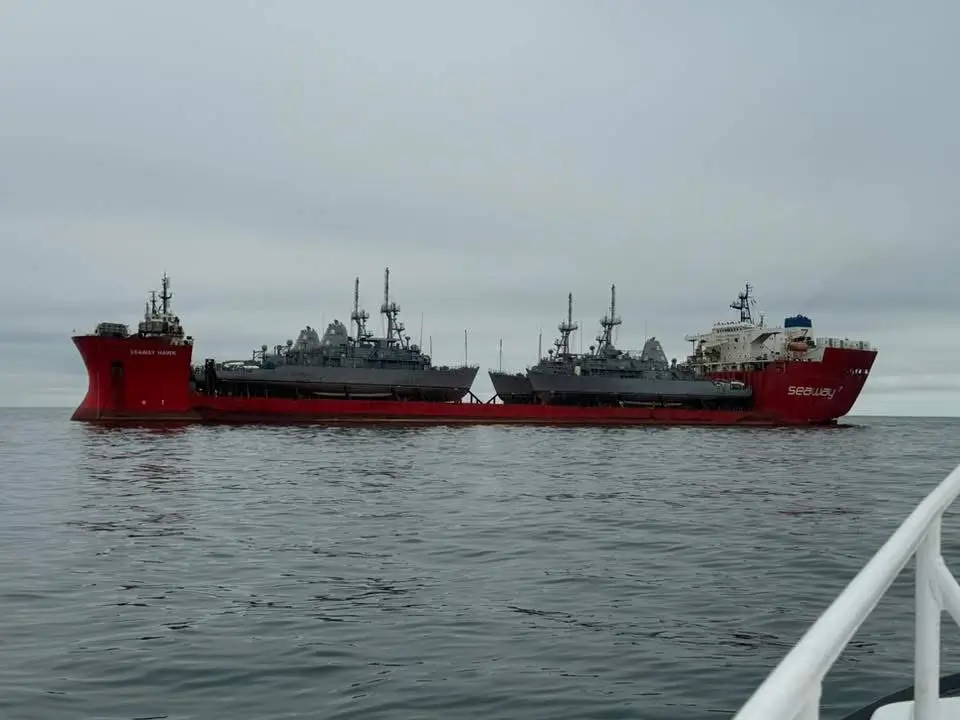
Four U.S. Navy Avenger-class minesweepers on board a heavy-lift ship in the Delaware River, on their way to Philadelphia for disposal. Posted March 9 to X. Source: @WarshipCam (Spendley & Johnston, 2026)
On paper, yes. The Navy’s replacement path is the Independence-class Littoral Combat Ship (LCS) equipped with the Mine Countermeasures Mission Package. But that answer is too simple for the reality before us. This is not a clean one-for-one handoff from a purpose-built mine warfare platform to a mature successor. It is a transition from an aging but specialized hull to a more distributed, more networked, and still-maturing system. That distinction matters, especially when the strategic consequences of failure are this high (Ceder, 2026; Johnston, 2025).
The deeper issue is not whether the Navy can point to a program of record and call it a replacement. The deeper issue is whether the United States has the capacity, resilience, and command architecture to clear and keep clear a mined chokepoint like the Strait of Hormuz under contested conditions. Michael Knights put it plainly more than a decade ago when he wrote that, for decades, the United States had systematically under resourced countermine warfare and accepted dangerous shortfalls in the Gulf. He also noted that experts believed as many as sixteen MCM vessels might be required to keep Hormuz clear of mines. The age of the quote is not the weakness. The fact that it still feels current is the problem (Knights, 2012).
There are replacements for the Avenger platform, namely the Independence-class LCS. But the Navy’s newer MCM approach comes with caveats. The LCS was originally sold as a modular ship that could swap packages based on mission. In practice, that vision has narrowed. As Naval News reported, space constraints and equipment requirements have pushed the Mine Countermeasures Mission Package toward a far more fixed configuration than originally advertised. That is not a trivial adjustment. It means the platform has drifted away from the modular concept that justified so much of its early logic and toward a more dedicated role as a mine warfare asset, but on a hull that was not purpose-built for mine warfare in the way its predecessors were (Johnston, 2025).
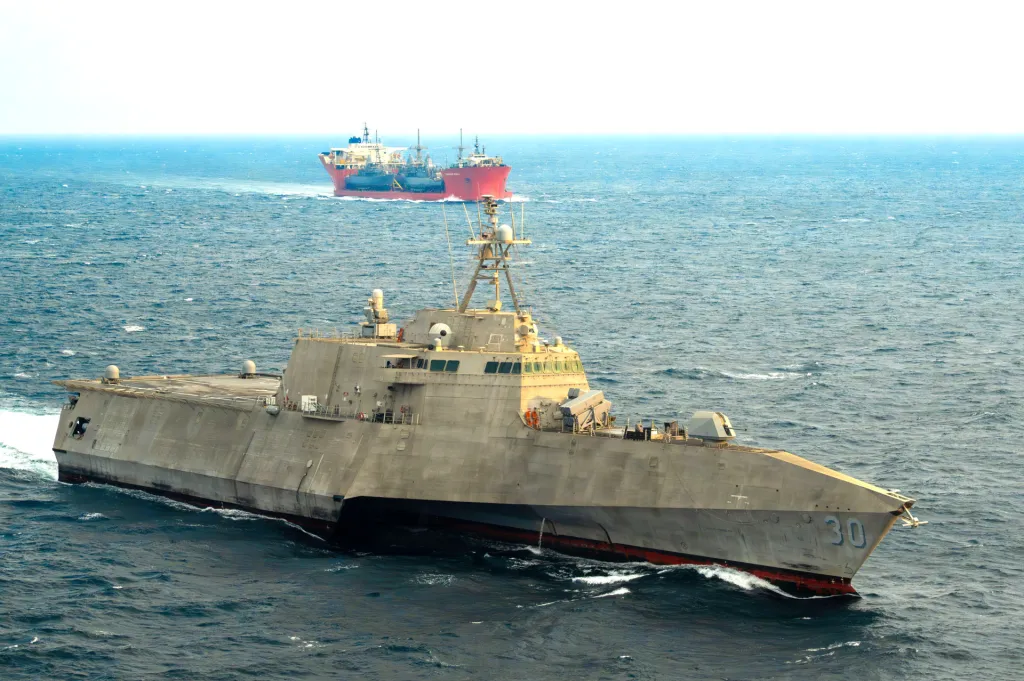
The Independence class LCS USS Canberra, in front, sails together with the M/V Seaway Hawk carrying the decommissioned Avenger class on January 20, 2026. USN (Trevithick, J., & Altman, H. 2026, March 15).
That does not mean the platform is irrelevant. It is not. The LCS MCM package brings unmanned surface systems, aviation integration, offboard sensing, and a degree of standoff that legacy platforms could not match. It also brings more self-defense capability than the wooden-hulled Avenger class ever had. But this package is still relatively new, its operational history is short, and its deployment experience remains limited. Demonstrating capability is not the same thing as sustaining clearance operations in a contested maritime corridor under real operational pressure (Ceder, 2026; Johnston, 2025).
The economic implications alone should end any temptation to treat mine warfare as a niche naval function. Reuters reported in March 2026 that maritime war-risk insurance premiums tied to Gulf transit had surged sharply as conflict widened, in some cases by more than 1000%. Reuters also noted that roughly one-fifth of the world’s oil consumption passes through the Strait of Hormuz. Mine warfare stops being an obscure fleet function very quickly when it shows up in shipping delays, insurance markets, and global energy prices (Hussain & Saini, 2026).
Unmanned systems absolutely play a role here, but this is not a challenge you solve by buying a pile of robots and calling it innovation. Plenty of companies can say they can find, fix, and finish mines. Far fewer can address the problem holistically. This is a communications problem. It is a kill-chain problem. It is a positive-identification problem. It is a software problem, a hardware problem, and a data problem. Most of all, it is an integration problem. That is where serious mine warfare consulting, maritime autonomy consulting, and digital twin maritime operations work actually matter, because the gap is rarely a single platform. The gap is usually the architecture that binds the force together. The article’s forward-looking claims in this paragraph are my analysis, informed by the operational and force-structure issues raised in the cited reporting and analysis (Ceder, 2026; Johnston, 2025; Knights, 2012).
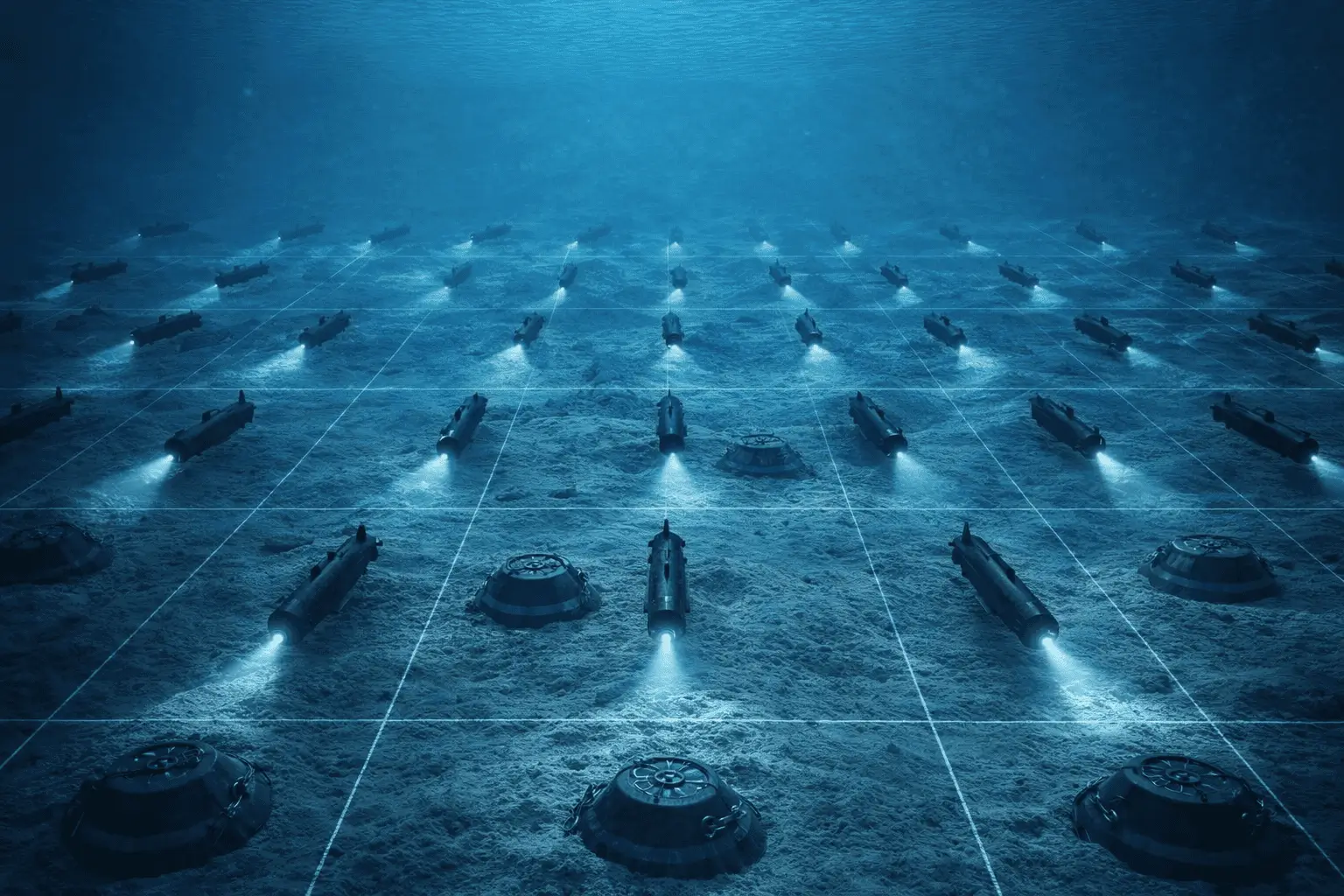
In the not-too-distant future, a commander should be able to deploy one hundred platforms from multiple launch points, push them into defined operational boxes, and have them begin parallel underwater searches across 2-by-2 square nautical mile sectors. Those systems should be able to relay contacts to surface and airborne nodes, contribute to a cohesive mosaic, and update that picture in near real time. That future will likely resemble an Internet of Things approach at sea, with vehicle-to-vehicle communication, machine-enabled scheduling, autonomy management, and heavy use of digital twins before the mission ever begins (Johnston, 2025; Knights, 2012).
But today, we are not there yet. Today, we are still fighting over what language the systems will speak, how they will pass data, who owns the tactical picture, how positive identification will occur, and how commanders will trust the mosaic enough to act on it. Until those issues are solved, scale remains more aspiration than capability. That is the real problem behind the Avenger conversation. The Navy has a replacement path. What it does not yet have is a fully mature, deeply integrated, and operationally proven replacement system (Ceder, 2026; Johnston, 2025).
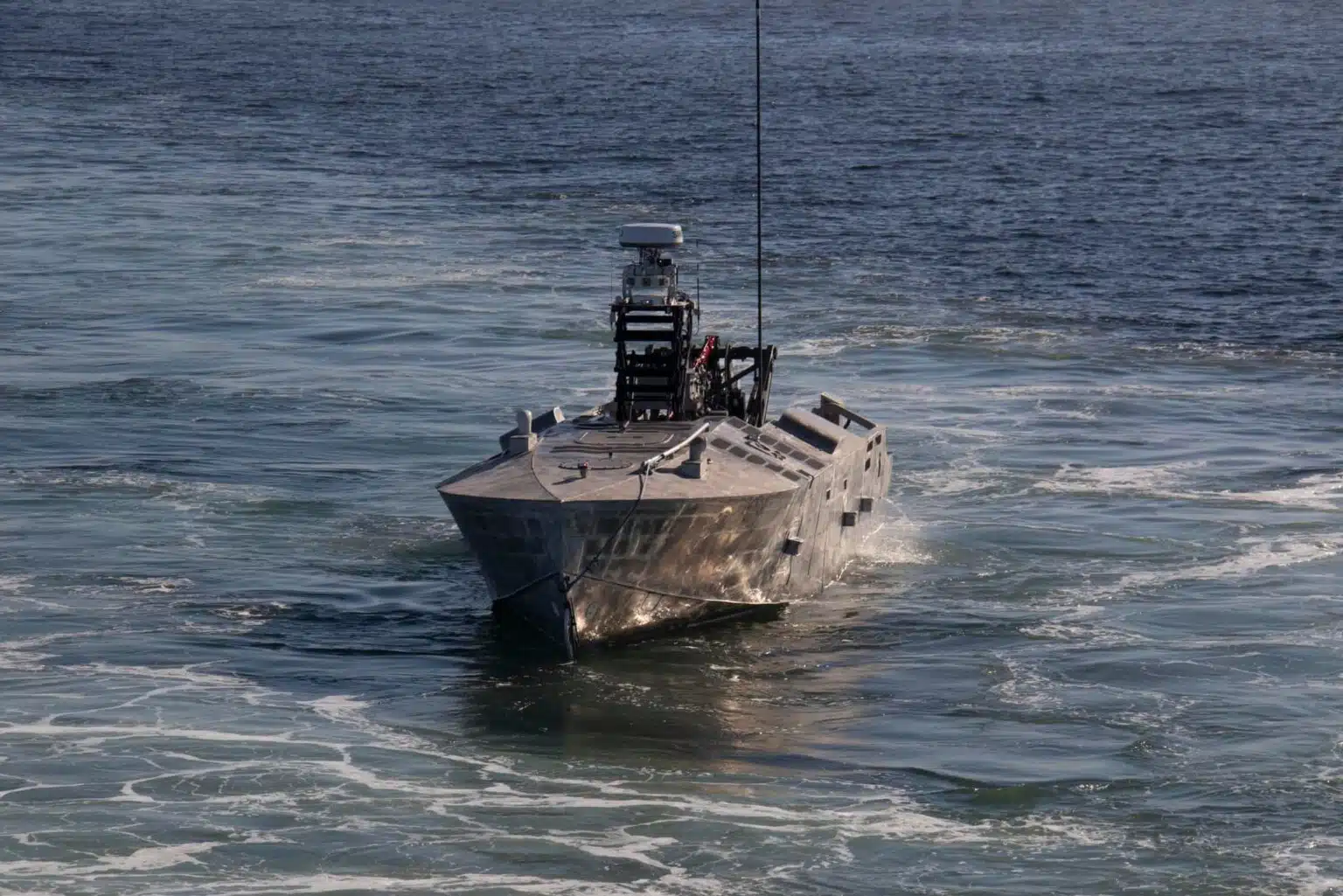
A mine warfare Fleet-class CUSV deploys off the stern of the USS Santa Barbara during qualification testing in the Pacific. (U.S. Navy photo) (Johnston, 2025)
For Black Marlin Defense, that is the opportunity and the mission. We help founders, funders, and government solve hard maritime problems from seabed to space. That includes mine warfare consulting, maritime autonomy consulting, unmanned maritime systems integration, LCS MCM transition analysis, digital twin maritime operations, and broader strategic work tied to Strait of Hormuz mine warfare, contested logistics, and next-generation maritime capability. If the challenge is connecting technology to operations, platforms to kill chains, and data to decisions, that is where we operate.
If your team is working on mine countermeasures, maritime autonomy, contested logistics, or unmanned maritime systems, Black Marlin Defense can help connect the operational problem to the technical solution. We support founders, funders, and government with strategy, concept development, operational integration, technical diligence, and digital twin-informed thinking, from seabed to space.
References
Ceder, R. (2026, March 12). The US Navy decommissioned Middle East minesweepers last year. Here’s what they did. Navy Times. https://www.navytimes.com/news/your-navy/2026/03/12/the-us-navy-decommissioned-middle-east-minesweepers-last-year-heres-what-they-did/
Hussain, N. Z., & Saini, M. (2026, March 6). Maritime insurance premiums surge as Iran conflict widens. Reuters.
https://www.reuters.com/world/middle-east/maritime-insurance-premiums-surge-iran-conflict-widens-2026-03-06/
Johnston, C. (2025, January 4). Update on the U.S. Navy’s Littoral Combat Ship Mine Countermeasures Mission Package. Naval News.
https://www.navalnews.com/naval-news/2025/01/update-on-the-u-s-navys-littoral-combat-ship-mine-countermeasures-mission-package/
Knights, M. (2012, September 28). Political-military challenges of demining the Strait of Hormuz. The Washington Institute for Near East Policy. https://www.washingtoninstitute.org/policy-analysis/political-military-challenges-demining-strait-hormuz
Spendley, B., & Johnston, C. (2026, March 13). Demining Hormuz: How the U.S. Navy arrived at worst-case scenario unprepared. Hunterbrook Media.
https://hntrbrk.com/demining-hormuz/
Trevithick, J., & Altman, H. (2026, March 15). U.S. Navy minesweepers assigned to Middle East have been moved to Pacific (Updated). The War Zone.
https://www.twz.com/sea/u-s-navy-minesweepers-assigned-to-middle-east-have-been-moved-to-pacific