United Nations Convention on the Law of the Sea
The United Nations Convention on the Law of the Sea, or UNCLOS, is the foundational legal framework for how states use the oceans. It governs territorial seas, exclusive economic zones, continental shelves, navigation and overflight rights, marine environmental obligations, dispute settlement, and the legal regime for mining seabed resources beyond national jurisdiction. The convention was adopted in 1982 and entered into force in 1994; as of March 30, 2026, it has 157 signatories and 172 parties.
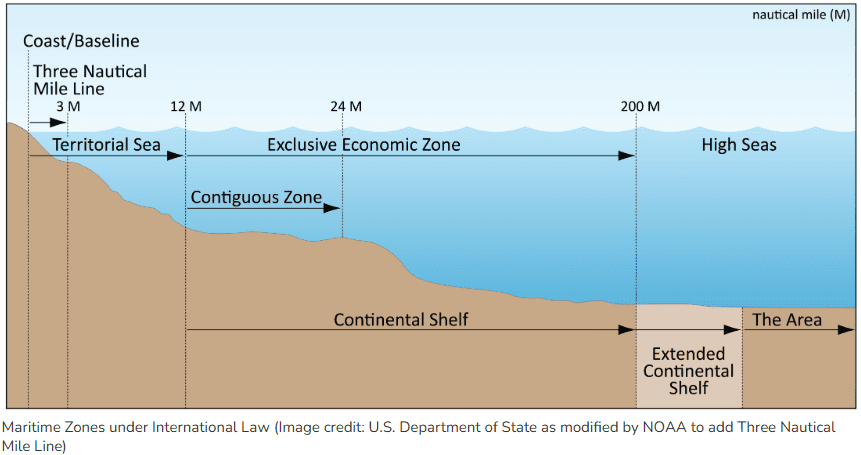
For the maritime domain, UNCLOS is not an academic instrument. It shapes who can transit choke points, who can collect resources in a 200 nautical mile EEZ, who can lay submarine cables, how states frame excessive maritime claims, and who has a seat at the table when seabed resources outside national jurisdiction are regulated.
That raises a harder question for the United States. How does Washington invoke UNCLOS-based rules to challenge excessive maritime claims, defend freedom of navigation, and push back on adversaries, while never having ratified the convention itself? And does that posture become more costly as the maritime competition shifts from access and transit to strategic control of critical seabed minerals?
How we got here
Before UNCLOS, the law of the sea was a patchwork. The 1958 Geneva conferences produced important conventions, but they failed to resolve two of the most important issues: the breadth of the territorial sea and fishery limits. A second conference in 1960 failed again. In practice, that meant states kept pressing competing maritime claims, and the legal baseline remained unstable.
By the time the Third United Nations Conference on the Law of the Sea began in 1973, the need was obvious. States needed a single framework that could reconcile coastal-state resource claims with enduring freedoms of navigation and overflight. The EEZ emerged from that process as a compromise: coastal states would gain sovereign rights over natural resources out to 200 nautical miles, while other states would retain high-seas freedoms such as navigation and overflight.
That compromise is now the global baseline. China signed UNCLOS on December 10, 1982 and ratified it on June 7, 1996. Russia signed on December 10, 1982 and ratified on March 12, 1997. Both joined the convention, but both also used Article 298 declarations to shield sensitive categories of disputes from compulsory settlement. China also declared that coastal states may require prior approval or notification for foreign warship passage through their territorial sea, a position the United States rejects.
That is what makes the United States unusual. It is the world’s leading maritime power, it operates globally based on many UNCLOS rules, and yet it remains outside the convention. Even the Navy JAG Corps frames that as an anomaly, noting that over 160 nations and the European Union are party, but not the United States. Among the permanent members of the UN Security Council, the U.S. is the outlier.
What the United States accepted, and what it rejected
The U.S. never rejected the entire law-of-the-sea project. Reagan’s 1983 oceans policy made the distinction explicit. He said the convention’s provisions on traditional uses of the oceans generally confirmed existing maritime law and practice, and that the United States would act in accordance with them. What he rejected were the deep-seabed mining provisions.
The objection centered on Part XI, the regime for seabed mining in areas beyond national jurisdiction. Reagan argued that the original mining regime would deter development of seabed minerals, deny the U.S. a fair role in decision-making, permit treaty amendments to bind the U.S. without U.S. approval, require mandatory transfer of private technology, and fail to assure access for future qualified miners. He also noted that while commercial economics did not yet justify development at the time, the deep seabed could become an important future source of strategic minerals.
The Senate Foreign Relations Committee later summarized the broader Reagan-era objections in even plainer terms: inadequate U.S. voting power, mandatory technology transfer, production limitations, onerous financial obligations, and the creation of a subsidized international mining entity that could compete unfairly with commercial operators.
The Fix
That is why the 1994 Part XI Implementing Agreement matters. Between 1990 and 1994, the U.S. participated in consultations designed to fix the deep seabed provisions. The resulting agreement, signed by the United States on July 29, 1994 and sent to the Senate by President Clinton, was explicitly designed to cure the earlier objections. According to the Senate report, it eliminated mandatory technology transfer and production controls, guaranteed the U.S. a seat on the key decision-making body, and restructured the regime along more market-oriented lines. Navy JAG notes that there has been bipartisan presidential support for accession since those 1994 fixes were agreed.
And yet the Senate never ratified the convention. So the U.S. has spent decades in a halfway house: operationally aligned with much of UNCLOS, politically outside it, and institutionally absent from the bodies that interpret and administer parts of it.
Modern practice: freedom of navigation, EEZ disputes, and the credibility gap
The modern U.S. position is legally coherent, even if politically awkward. The Department of Defense states that customary international law, as reflected in UNCLOS, recognizes both the rights of coastal states in their maritime zones and the rights and freedoms of all nations to use the sea. That is the basis for the U.S. Freedom of Navigation Program, which combines diplomatic protests and operational assertions to challenge excessive maritime claims. In fiscal year 2023 alone, U.S. forces challenged 29 excessive maritime claims asserted by 17 different claimants.
The EEZ is central to this posture. In its 1983 EEZ proclamation, the United States asserted sovereign rights over resources and related jurisdiction within 200 nautical miles, while also affirming that the EEZ remains beyond the territorial sea and that all states retain high-seas freedoms there, including navigation, overflight, and the laying of submarine cables and pipelines. In other words, an EEZ is not sovereign water. It is a resource zone with preserved transit freedoms.
Distinction
In April 2024 and again in February 2025, the United States joined maritime cooperative activities in the Philippine EEZ and explicitly described those operations as support for freedom of navigation, overflight, and maritime rights under international law as reflected in UNCLOS. The U.S. is plainly leaning on UNCLOS language when it coordinates with allies and partners in contested waters.
The same framework drives U.S. objections to Chinese behavior. The Defense Department’s 2024 China military power report states that the PRC has long challenged foreign military activities in its claimed EEZ in a manner inconsistent with customary international law reflected in UNCLOS. The same report notes that China also conducts similar activities in the EEZs of other states, including the United States, which it describes as a double standard. That is a useful reminder that near-peer competitors often want restrictive interpretations for others and permissive interpretations for themselves.
Credibility Gap
The Navy JAG position has long been unusually direct, even if some of that language has since been removed from the current page. Their central point was that accession would better preserve the Navy’s ability to move forces on, over, and under the oceans whenever needed. Admiral Greenert argued that the United States should not rely on custom and tradition when a formal legal mechanism is available, because treaty membership would strengthen Washington’s hand against coastal states trying to restrict freedom of the seas. Former Secretary of the Navy Ray Mabus made a related point, warning that remaining outside UNCLOS weakens America’s position with other nations.
Washington can still make the legal argument, because many UNCLOS navigation and EEZ rules are treated as customary international law. But every time it invokes UNCLOS against an adversary while remaining outside the treaty, it invites the charge of selective enforcement. The law may hold. The persuasion gets weaker.
Why deep seabed mining changes the equation
The U.S. legal theory is strongest on navigation and EEZs because those rules are widely treated as customary law. Deep seabed mining is different. Once the issue shifts to mining in areas beyond national jurisdiction, you move out of the relatively stable world of navigational custom and into the much more institutional world of Part XI, the International Seabed Authority, permits, licensing, and control over strategic minerals. That is exactly where the original U.S. objections were concentrated.
The United States responded by building its own domestic path. Under the Deep Seabed Hard Mineral Resources Act, NOAA can issue exploration licenses and commercial recovery permits for polymetallic nodules in areas beyond national jurisdiction to U.S. companies, even though the U.S. is not party to UNCLOS. NOAA states this directly, and it also notes that the International Seabed Authority regulates such mining for countries that are parties to the convention.
Today
The White House’s April 24, 2025, executive order declared that the U.S. has a core national security and economic interest in deep-sea science, technology, and seabed mineral resources, and framed offshore critical minerals as part of a strategy to reduce dependence on foreign adversary control. It also called for partnerships with allies and industry to counter China’s influence over seabed mineral resources, including in partner EEZs. NOAA then updated the U.S. regulatory machinery, issuing a final rule on January 21, 2026 revising application rules under DSHMRA.
NOAA’s own status page shows how early this still is. Lockheed Martin holds two exploration licenses issued in 1984, but NOAA lists no existing commercial recovery permits. At the same time, NOAA has begun processing new activity: by March 2026 it had published notice that amended exploration applications from AMR and SeaX, both subsidiaries of American Metal Resources, were fully compliant.
This is where the UNCLOS tension sharpens. For freedom of navigation, the U.S. can plausibly say, “these are customary rules and we act accordingly.” For deep seabed mining, the institutional architecture matters more, and the U.S. has chosen a parallel domestic route rather than accession. That may be legally defensible under U.S. law. It is still strategically messier.
Why this matters now
The commercial case for mass-scale deep seabed mining is still immature. The regulatory record itself shows that: NOAA has no commercial recovery permits on the books, TMC still reports no revenue to date, and Odyssey’s current revenue is small and tied to marine services rather than full-scale mineral production. In other words, policy momentum is outrunning commercial maturity.
But the strategic case is maturing faster than the commercial case. The April 2025 executive order explicitly links seabed minerals to defense, infrastructure, energy security, and independence from foreign adversary control. It also frames U.S. seabed policy as a response to China’s influence over mineral supply chains and as a tool for supporting partners in their own EEZs. That is a strong signal that seabed resources are moving out of the environmental-and-theoretical lane and into the national-security lane.
That does not mean the economics are solved. It does mean the planning horizon has changed. If certain mineral chains remain concentrated in adversary-controlled or adversary-influenced ecosystems, and if undersea resources offer an alternative path, then seabed mining will not stay a niche conversation. It will become a strategic competition issue that sits at the intersection of maritime operations, industrial policy, environmental credibility, and alliance management. The key question is no longer whether undersea mining is politically controversial. It is whether the U.S. wants to arrive late to a domain it now openly describes as strategically important. That final point is an inference from the policy direction, the regulatory changes, and the company activity now moving through the system.
The market: three companies worth watching
Impossible Metals
Impossible Metals is the most distinct technical bet in the field because it is trying to win on collection architecture, not just access to acreage. The company’s Eureka system is built around untethered AUVs, selective harvesting, and hovering above the seabed to reduce sediment disturbance and avoid detected life on nodules. The company says it began work on the architecture in 2020, completed a Eureka I proof-of-concept in 2022, completed a Eureka II deep-water test in April 2024, and finished the Eureka III Mk1 design in 2025. It also says it has raised around $15 million across pre-seed, seed, grants, and additional investor funding.
Strategically, Impossible Metals is interesting because it is pushing through a U.S. jurisdictional pathway rather than relying only on the ISA route. BOEM states that it received an unsolicited request from Impossible Metals on April 8, 2025 for an offshore American Samoa lease sale, beginning the first step toward possible leasing of OCS seabed critical minerals. I did not find a public revenue disclosure in the sources reviewed, which suggests the company is still primarily a venture and technology story rather than a production story.
TMC / TMC USA
TMC is the scale bet. It is pursuing polymetallic nodules in international waters and remains the most aggressive company in trying to move from environmental campaigns and pilot collection toward a commercial permit pathway. In 2022, TMC and Allseas demonstrated collection and lift of more than 3,000 tonnes of nodules from depths greater than 4 kilometers. In January 2026, TMC USA announced what it described as the first consolidated exploration-license and commercial-recovery application under NOAA’s new process, covering about 65,000 square kilometers and an estimated 619 million tonnes of wet nodules.
Financially, TMC is much farther along than most startups, but it is still not a revenue-producing mining company. It announced a $37 million strategic investment in May 2025, ended 2025 with about $117.6 million in cash, and stated in its 10-Q that it is a pre-revenue company with no revenue to date. Its earlier public-market combination included roughly $330 million of PIPE financing on top of the SPAC trust. That combination of capital access, permitting aggression, and scale ambition makes TMC the market’s clearest commercial bellwether, even if commercial operations are still not here.
Odyssey Marine Exploration
Odyssey is the diversified operator in the group. Unlike a pure nodule startup, Odyssey is building a broader portfolio across phosphate, polymetallic nodules, and other subsea resources while also marketing research, marine operations, and regulatory compliance support to governments and rights holders. The company says it works with governments and seafloor rights holders worldwide, and its recent milestones include a Mid-Atlantic BOEM lease-sale request, deployment of Autonomous Benthic Mini Landers in the Cook Islands EEZ at 5,000 meters depth, and a fertilizer-focused joint venture in Mexico’s EEZ.
Odyssey is also one of the few companies in this lane with at least some operating revenue, though it remains small. Its SEC filing shows $330,975 in revenue for the first nine months of 2025, primarily from marine services. It also reported more than $8 million raised in 2025, plus substantial debt conversion, and said operations were funded into 2026. That makes Odyssey less of a moonshot extractor and more of a hybrid platform, part project developer, part offshore services and regulatory partner.
The market takeaway is straightforward. This is still an early, policy-shaped, capital-intensive sector. The field is no longer theoretical, but it is not yet commercially mature. The most sophisticated readers should watch not only who has the best robot or best acreage, but who can survive the regulatory path, raise follow-on capital, build credible environmental permission structures, and align with the strategic objectives now coming out of Washington.
Conclusion
This is not just a law-of-the-sea problem. It is not just a mining problem either. It is a synthesis problem. The actor that wins in this space will need to understand naval operations, EEZ politics, treaty architecture, seabed systems, environmental risk, industrial supply chains, and the pace and limits of government acquisition.
That is why this issue matters beyond the courtroom and beyond the conference circuit. Founders will need to translate technical claims into policy and regulatory credibility. Investors will need to diligence not only ore bodies and vehicles, but also maritime legal risk and sovereign positioning. Government program managers will need partners who understand how operational access, alliance politics, and industrial capacity fit together in one maritime system.
The Challenge
The United States has managed the UNCLOS contradiction for decades by leaning on customary law where it suits U.S. maritime interests and rejecting treaty machinery where it does not. That posture has been workable in a world centered on transit rights. It becomes much harder in a world centered on strategic control of seabed minerals. The next chapter will not be written by lawyers alone. It will be written by the people who can connect maritime technology, international law, industrial strategy, and operational reality before the market fully catches up.
References
American Society of International Law. (n.d.). Beyond national jurisdiction: Oceans.
https://www.asil.org/topics/signaturetopics/BNJ/oceans
Browne, M. A. (2006). The Law of the Sea Convention and U.S. policy. Congressional Research Service. https://www.gc.noaa.gov/documents/gcil_crs_2006_report.pdf
Bureau of Ocean Energy Management. (2025, November 7). Area identification recommendation for the American Samoa Outer Continental Shelf (OCS) mineral leasing process [Memorandum].
https://www.boem.gov/marine-minerals/area-id-memoamerican-samoa-ocs-mineralssignedwithattachementpdf
Federal Register. (2026, March 23). Deep seabed mining: Notice of receipt of applications for deep seabed mining exploration licenses and announcement of public comment period and virtual public hearings.
https://www.federalregister.gov/documents/2026/03/23/2026-05599/deep-seabed-mining-notice-of-receipt-of-applications-for-deep-seabed-mining-exploration-licenses-and
Groves, S. (2026, March 25). The UN is trying to block America from mining the seabed. The National Interest.
https://nationalinterest.org/blog/energy-world/the-un-is-trying-to-block-america-from-mining-the-seabed
Impossible Metals. (n.d.). FAQs: Impossible Metals Company.
https://impossiblemetals.com/frequently-asked-questions/faqs-impossible-metals-company/
Impossible Metals. (n.d.). Polymetallic nodules harvesting | robotic collection system.
https://impossiblemetals.com/technology/robotic-collection-system/
Odyssey Marine Exploration. (2025, August 4). Odyssey Marine Exploration announces funding and continued progress across its mineral resource project portfolio. Business Wire.
https://www.businesswire.com/news/home/20250804340541/en/Odyssey-Marine-Exploration-Announces-Funding-and-Continued-Progress-Across-Its-Mineral-Resource-Project-Portfolio
Odyssey Marine Exploration, Inc. (2025). Quarterly report (Form 10-Q) for the quarterly period ended September 30, 2025. U.S. Securities and Exchange Commission.
https://www.sec.gov/Archives/edgar/data/798528/000119312525275786/omex-20250930.htm
Reagan, R. (1982, July 9). Statement on United States actions concerning the Conference on the Law of the Sea. Ronald Reagan Presidential Library and Museum.
https://www.reaganlibrary.gov/archives/speech/statement-united-states-actions-concerning-conference-law-sea
Reagan, R. (1983, March 10). Proclamation No. 5030: Exclusive economic zone of the United States of America. National Archives. https://www.archives.gov/federal-register/codification/proclamations/05030.html
Reagan, R. (1983, March 10). Statement on United States oceans policy. Ronald Reagan Presidential Library and Museum. https://www.reaganlibrary.gov/archives/speech/statement-united-states-oceans-policy
The Metals Company. (2025, May 12). TMC announces $37 million strategic investment to advance deep-sea mineral development. https://investors.metals.co/news-releases/news-release-details/tmc-announces-37-million-strategic-investment-advance-deep-sea/
The Metals Company. (2026, January 22). TMC USA files first consolidated deep-seabed mining application, increasing expected commercial recovery permit area to 65,000 km2.
https://investors.metals.co/news-releases/news-release-details/tmc-usa-files-first-consolidated-deep-seabed-mining-application/
The Metals Company. (2026, March 27). TMC announces fourth quarter and full year 2025 results.
https://investors.metals.co/news-releases/news-release-details/tmc-announces-fourth-quarter-and-full-year-2025-results/
Trump, D. J. (2025, April 24). Unleashing America’s offshore critical minerals and resources [Executive order]. The White House. https://www.whitehouse.gov/presidential-actions/2025/04/unleashing-americas-offshore-critical-minerals-and-resources/
United Nations. (n.d.). 1958 Geneva Conventions on the Law of the Sea. Audiovisual Library of International Law. https://legal.un.org/avl/ha/gclos/gclos.html
United Nations. (n.d.). United Nations Convention on the Law of the Sea. Audiovisual Library of International Law. https://legal.un.org/avl/ha/uncls/uncls.html
United Nations. (n.d.). United Nations Convention on the Law of the Sea. United Nations Treaty Collection. https://treaties.un.org/pages/ViewDetailsIII.aspx?Temp=mtdsg3&chapter=21&clang=_en&mtdsg_no=XXI-6&src=TREATY
U.S. Department of Defense. (2022, December 6). Annual freedom of navigation report: Fiscal year 2022 [Report to Congress]. https://policy.defense.gov/Portals/11/Documents/FON%20Program%20Report_FY2022.pdf?ver=8of4c3mCAOnzfa4AfTYIyg%3D%3D
U.S. Department of Defense. (2024, April 5). Joint statement: Australia–Japan–Philippines–United States maritime cooperative activity. https://www.defense.gov/News/Releases/Release/Article/3733095/joint-statement-australia-japan-philippines-united-states-maritime-cooperative/
U.S. Department of Defense. (2024, December 18). Military and security developments involving the People’s Republic of China 2024: Annual report to Congress.
https://media.defense.gov/2024/Dec/18/2003615520/-1/-1/0/MILITARY-AND-SECURITY-DEVELOPMENTS-INVOLVING-THE-PEOPLES-REPUBLIC-OF-CHINA-2024.PDF
U.S. Navy Judge Advocate General’s Corps. (n.d.). Law of the sea.
https://as-jece-cms-dev-usgva.azurewebsites.us/national-security/law-of-the-sea/
U.S. Senate Committee on Foreign Relations. (2004, March 11). United Nations Convention on the Law of the Sea (Exec. Rept. 108-10). https://www.foreign.senate.gov/imo/media/doc/executive_report_108-10.pdf
National Oceanic and Atmospheric Administration. (n.d.). Deep seabed hard mineral resources act.
https://www.noaa.gov/digital-collections/deep-seabed-hard-mineral-resources-act
National Oceanic and Atmospheric Administration. (n.d.). Deep seabed hard minerals mining.
https://oceanservice.noaa.gov/deep-seabed-mineral-resources/deep-seabed-mining/